Monitoring Infrastructure Projects in the Russian Arctic
Analysis of Economic Activity
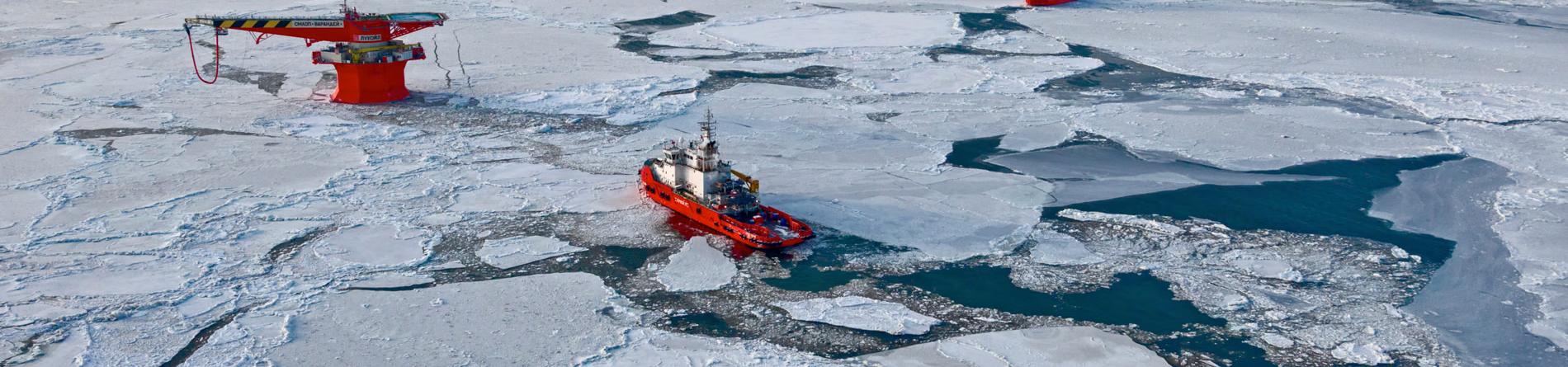
Russia views its Arctic territories as a strategic resource reserve essential for potential economic growth. At the same time, economic activity in the region has a significant impact on the ecosystem of the entire Arctic and adjacent areas, exacerbating the global climate crisis. While the state and major corporations focus on implementing large-scale infrastructure projects, the concerns of Indigenous communities and environmental advocates are often ignored.
The goal of Arctida’s monitoring initiative is to draw attention to the activities of major economic actors, which have become increasingly opaque since February 2022.
Context
How Did the Project Begin?
Since 2022, Arctida has been engaged in systematic monitoring of economic activity in the Russian Arctic. We have studied key Arctic stakeholders, compared satellite images of the tundra to identify violations, and analyzed changes in political power. Our work inevitably focuses on three interrelated dimensions.
- Every major project affects the natural environment, making it necessary to assess climate and environmental risks.
- Environmental risks and impacts, in turn, affect the implementation of Indigenous peoples’ rights as enshrined in international law. This type of analysis makes it possible to assess the extent to which the interests of Arctic communities are taken into account.
- Finally, each project involves an interplay of state and corporate interests. As part of our monitoring, we identify ownership structures, opaque supply chains, interest groups within government, and the influence of the international context.
The 2025–2026 monitoring cycle includes an analysis of six projects. These include mineral extraction and processing projects, as well as initiatives in transportation and logistics. The projects span a wide geographic area—from Murmansk Oblast to the Chukotka Autonomous Okrug—covering several regions that are part of, or adjacent to, the Arctic zone of the Russian Federation.
Projects
The Northern Sea Route
A maritime transport corridor under the sovereign control of the Russian Federation, connecting Europe and Asia via the Arctic Ocean. Its development requires the modernization of ports, the construction of land access infrastructure, and an expansion of mineral extraction in the Arctic to ensure a stable cargo base. The project is overseen by the state corporation Rosatom. At present, year-round navigation along the route is not possible.
Construction of the Baimsky Mining and Processing Plant
The Baimsky Mining and Processing Plant is one of the largest infrastructure projects in the Arctic for the development of the Peschanka deposit in Chukotka. Its resources are estimated at 9.9 million tons of copper and 16.6 million ounces of gold. In addition to the plant, the project involves the construction of a road and a terminal at Cape Naglëynyn, where floating nuclear power units will be installed to provide energy. Investments amount to 1.1 trillion rubles, and the launch is scheduled for 2029. Due to the 2022 sanctions, the project changed its ownership structure, which led to a shift in the implementation schedule.
Key findings of Arctida:
Yamal LNG
Lavna Coal Terminal
Cover photo: Justin Jin.